Builder incentives became the price, not the promotion
Builder incentives now run 63% of US homebuilders and 10.9% of sale price at Pulte. The discount stopped being a promotion and became the price.
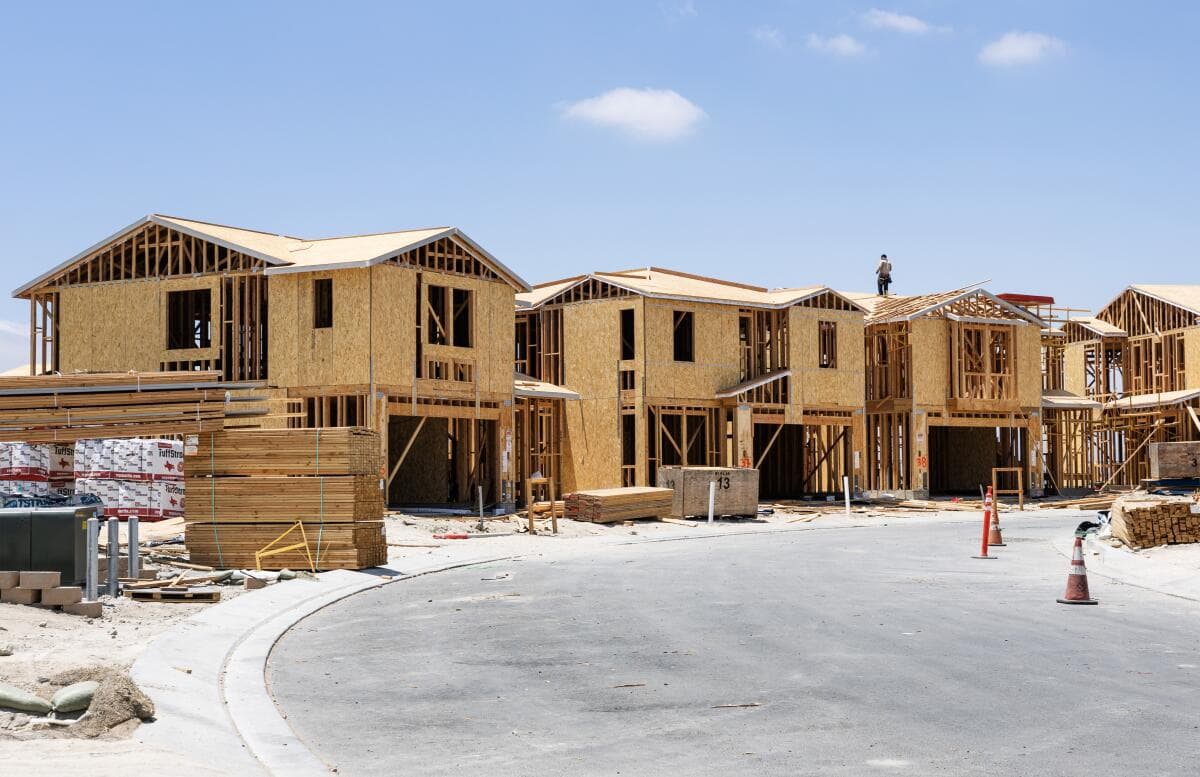
In April 2026, the price premium a buyer paid for a newly built American home turned negative for the first time in five decades of data. Census figures put the median new home at $403,200 against $404,600 for an existing one, a gap of $1,400 in the buyer's favor. The new house is now the cheap house.
That inversion did not happen because builders got more efficient. It happened because they bought the demand. Sixteen consecutive months of heavy discounting have quietly rewritten how a new home is priced in the United States, and the rewrite does not show up in any published price index.
A builder incentive is any value transferred to close a sale without cutting the contract price: a mortgage rate buydown, paid closing costs, design center credits, or covered association dues. Because it sits outside the headline price, the Census median records a market holding firm while the economics underneath are marked down by double digits.
What counts as a builder incentive in 2026?
The dominant form is the rate buydown, where the builder pays lenders upfront to deliver a below-market fixed mortgage. Design credits and closing-cost coverage follow. John Burns Research and Consulting tracks the combined value at roughly 7% to 8% of new home sale prices, a level its research manager Alex Thomas called abnormal against historical norms, noting that the true discount can run higher in individual markets because design credits, buydowns and covered closing costs never reach the Census price data.
The scale is easier to grasp in dollars. PulteGroup ran sales incentives at 10.9% of gross sales price in the first quarter of 2026, which ResiClub calculated as about $54,500 on a $500,000 home. Two years earlier the same figure was 6.3%, and the normalized historical range is 3.0% to 3.5%. CEO Ryan Marshall was direct about the trade: the ability to offer low fixed rate mortgages helps solve the affordability riddle for some, but it comes at a price.
Why are homebuilder margins shrinking in 2026?
Because the incentive is paid out of gross margin, every point of discount lands in the same place. Orders can rise while profit falls, which is exactly the pattern the second quarter produced across the sector. The spread between the strongest and weakest operator is now five percentage points of gross margin in an identical rate environment.
| Builder | Period | Gross margin | Incentive level |
|---|---|---|---|
| PulteGroup | Q1 2026 | 24.4% | 10.9% of gross sales price |
| D.R. Horton | Fiscal Q3 2026 | 20.7% | Elevated, guidance cut |
| Lennar | Q2 2026 | 15.6% | About 12.9%, down from 14.1% |
| Sector norm | Pre-2022 | Pulte peaked at 29.6% in Q1 2023 | 3.0% to 3.5% |
Lennar's second quarter 2026 results show the volume strategy in its purest form: 20,519 deliveries, up 2%, on an average sales price of $371,000, with net margin at 6.4%. Executive chairman Stuart Miller pointed to a record low cycle time of 121 days and construction costs down another 2% sequentially. The company is manufacturing its way through the discount.
D.R. Horton chose the other side of the trade. Its fiscal third quarter held gross margin at 20.7% and pre-tax margin at 13.3%, with net sales orders essentially flat at 23,084 homes. It also cut full-year revenue guidance to a range of $32.5 billion to $33.0 billion, and told the market that sales incentives would stay elevated into the fourth quarter.
Free resource
When product is undifferentiated, price becomes the only argument
The builders holding margin are the ones whose buyers can name what they are buying. This is the framework we use to build that position before a launch.
Download the guide →Are builder incentives worth it?
For the buyer, usually yes, because a permanent rate buydown lowers the monthly payment more than an equivalent price cut would. For the builder, the answer has an expiry date. Incentives buy this quarter's absorption while training the next quarter's buyer to wait for a better deal, and that expectation is far harder to reverse than a price.
Five consequences follow once discounting becomes structural rather than tactical.
- Price indexes stop describing the market. Median new home prices look stable while realized economics fall 7% to 12%, so anyone underwriting from published data is reading a fiction.
- Appraisals and resale inherit the gap. A home recorded at full contract price but sold with $54,500 of value attached does not carry that support into the resale market.
- The buyer learns to wait. Sixteen months of standing offers convert a closing tactic into a consumer expectation.
- Scale beats craft in the short run. Cycle time and construction cost, not design, determine who survives a discounting cycle intact.
- Differentiated product becomes the only defensible margin. When every builder discounts, the one whose buyer can articulate why this house is different discounts least.
An incentive that runs for sixteen consecutive months is not a promotion. It is the price, recorded in the wrong column of the contract.
Where the industry disagrees
The sector is not reading its own data the same way, and the disagreement is the most useful thing in it. Lennar sees the peak behind it: incentives fell from 14.1% in the first quarter to about 12.9% in the second, and Miller framed the narrowing gap against a normalized 4% to 6% range as the first such move in three years. Recovery, in that reading, starts with the discount receding.
D.R. Horton told investors the opposite for the quarter ahead, guiding to elevated incentives and trimming revenue expectations. The NAHB/Wells Fargo Housing Market Index sides with caution: 63% of builders used sales incentives in July 2026, the sixteenth straight month at 60% or higher, with 37% cutting prices at an average reduction of 6%. The index itself sat at 34, down from 36 in June, below 50 for fifteen consecutive months, the longest stretch since 2012.
NAHB chief economist Robert Dietz put the constraint plainly, noting that with the index below 40 for fifteen straight months, affordability remains the industry's primary challenge. Chairman Bill Owens described buyers waiting on the sidelines for lower mortgage rates and a clearer economic outlook. Neither description supports the idea that discounting ends on its own.
What this means for developers and brands
The lesson generalizes well beyond American production housing. Discounting is what a market does when the buyer cannot tell two products apart. A rate buydown is a legitimate financial tool, but as a permanent operating condition it is an admission that the only remaining argument for the product is what it costs.
The builders defending margin in this cycle are doing it in two ways: manufacturing efficiency, as Lennar's 121-day cycle time shows, or product and location specificity that a competitor cannot copy in a season. Marketing cannot manufacture the first. It can and should be responsible for the second, which is why positioning work belongs upstream of a launch rather than in the quarter when absorption disappoints. Our brand and marketing work for developers starts there, and the wider argument is collected in the real estate market hub and across the editorial archive.
The discount is not evenly distributed
National medians hide four different markets. The negative new home premium recorded in April 2026 is a blended figure, and the regional spread behind it is wide enough to invert the conclusion depending on where a developer operates.
In the Northeast, existing homes still commanded roughly $309,200 more than new construction, a gap driven by scarce land and an older, better located resale stock. The Midwest showed a $66,800 premium for existing homes. The South, where production building concentrates, sat almost exactly at parity, with new homes just $700 above existing. Only the West kept a meaningful new construction premium, at $55,500.
Read as a map rather than an average, this says something builders rarely admit out loud: the discounting cycle is most severe precisely where the industry built the most standardized product. Where supply is constrained and each home is difficult to replicate, the premium survived. Where homes are interchangeable and inventory is deep, price became the only lever left.
The same logic applies to the timing of a recovery. If Lennar is right that incentives have peaked, the first markets to normalize will be the ones where product scarcity does the work that discounting is currently doing. If D.R. Horton is right that elevated incentives persist, the gap between those two kinds of markets widens further, and the assets built purely for volume absorb the damage. Either way, the variable that decides the outcome is not the mortgage rate. It is whether the buyer had a reason to choose that particular house before the incentive was mentioned.
Frequently asked questions
What are typical builder incentives right now?
Mortgage rate buydowns, paid closing costs and design center credits, combined at roughly 7% to 8% of sale price according to John Burns Research and Consulting. Individual builders run higher: PulteGroup reported 10.9% of gross sales price in the first quarter of 2026, against a historical norm near 3.0% to 3.5%.
Can you negotiate builder incentives?
Usually more successfully than you can negotiate the contract price. Builders protect the recorded price because it supports comparable sales across the community, so they prefer to concede value through financing and upgrades. Standing inventory and quarter-end closings are where the flexibility concentrates.
What is a good gross margin for a homebuilder?
Public builders operated in the mid to high twenties before 2022, with PulteGroup peaking at 29.6% in the first quarter of 2023. In 2026 the range runs from Lennar at 15.6% to D.R. Horton at 20.7%, so anything above 20% now counts as strong performance rather than a normal result.
Why is a new home cheaper than an existing one in 2026?
Because builders must clear inventory and existing owners do not. Locked-in low mortgage rates keep resale supply scarce and seller expectations high, while builders discount to move standing stock. The result was a negative new home premium in April 2026, the first in five decades of data.
Next step
If price is the only argument left for your product, the problem started before the campaign.
Talk to TBO →Cover image: LA Times
You may also like
Manhattan ultra-luxury surge: $20M+ contracts up 140%
Manhattan ultra-luxury sales rose 30% YoY to $7.5B in Q1 2026 while the broader market softened. Two markets sharing one zip code.

Dubai real estate 2026: the crash moved to 2027
Dubai's 2026 handover wave slipped into 2027. What corrected was the resale layer, not the market, and the real test now has a date.

Data centers are outbidding home builders for land
Data centers are outbidding home builders at up to 50x the county land median. What that does to housing supply, and what residential developers can still control.