London prime property: the buyer changed, not the address
London prime property in 2026: the index fell 4.9% while £15m-plus sales hit £1.24bn. The residents left and the buyers arrived. What the split means.
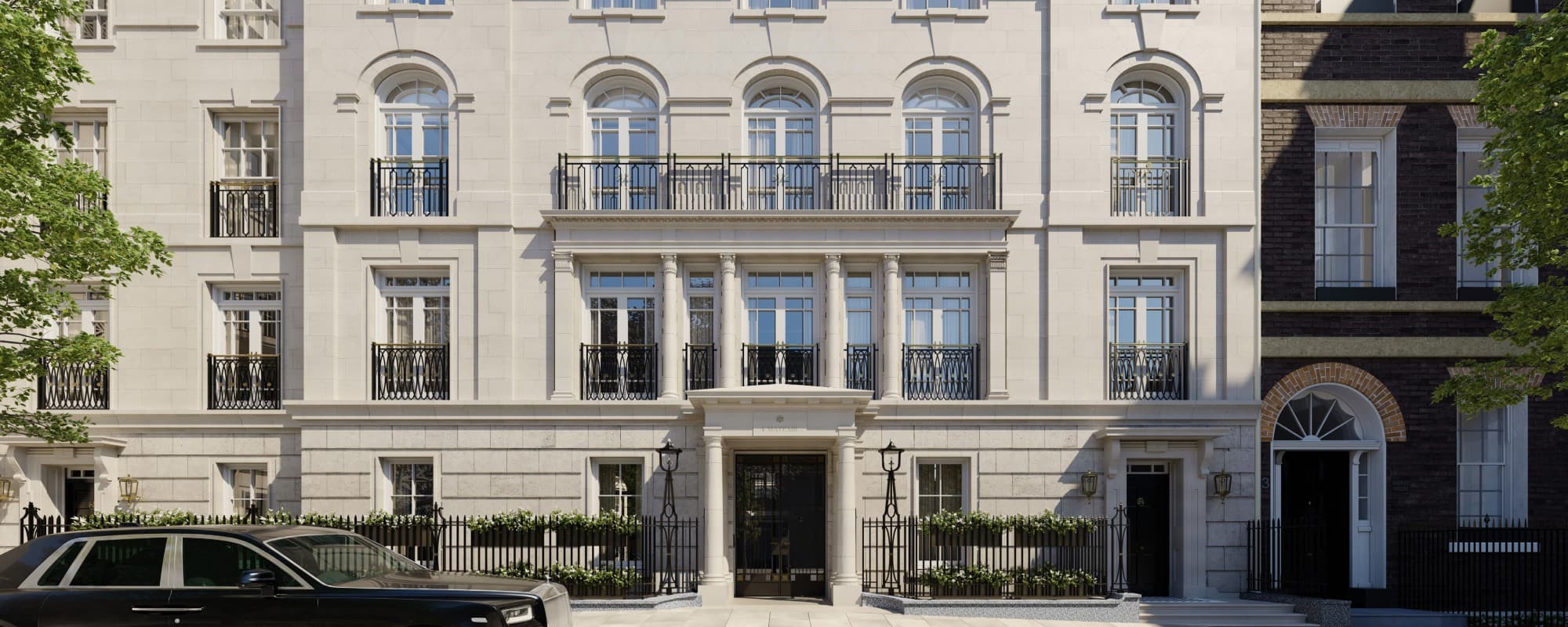
In the first half of 2026, two things happened to London property that are not supposed to happen at once. The price index for prime central London fell at its fastest annual pace in five years. And the market above £15 million posted its strongest six months of value since before the pandemic.
Most coverage picks one of those facts and calls it the story. Choosing either one produces a headline that is wrong. Together they describe something more interesting: London did not lose its luxury market. It lost the people who lived in it.
The index says one thing
The measured picture is genuinely poor. According to Knight Frank research, average prices in prime central London fell 4.9% in the year to February 2026. Prime outer London fell 0.5%, the widest annual decline in 21 months. Prime central London values now sit roughly 22% below their last peak, reached in August 2015. That is a decade of nominal stagnation in the most expensive residential postcodes in Europe.
Supply explains part of it. Sales instructions across London ran 16% above the five-year average in January 2026, while new buyer registrations came in 4% lower. More sellers, fewer buyers, and the arithmetic does the rest.
Volumes confirm it. LonRes recorded prime London transactions in the first six months of 2026 down 12.7% year on year, and 3.8% below the 2017-2019 benchmark. This is not a market clearing at a lower price. It is a market where fewer deals happen at all.
The top end says the opposite
Now hold that against the ultra-prime data. Research from Beauchamp Estates, reported by Elite Agent, counted 34 completed sales above £15 million between January and June 2026, against 27 in the same window of 2025. A 26% rise in deals. The value figure is the one that matters: £1.24 billion, up from £694.1 million, a 79% jump in six months.
The headline transactions were extraordinary by any historical standard. The Holme, the Regency villa inside Regent's Park, sold for £195 million to Abbas Sajwani. Nick Candy's Chelsea mansion traded at £275 million, the most expensive residential sale ever recorded in Britain.
So the index falls while the apex sets records. Both numbers are correct because they are measuring two different populations.
Are London property prices dropping?
Yes and no, depending on the bracket. Prime central London prices fell 4.9% in the year to February 2026 and remain about 22% below their 2015 peak, per Knight Frank. But sales above £15 million rose 26% in volume and 79% in value in the first half of 2026. The broad market is falling; the apex is not.
What actually changed: the buyer
In April 2025, the United Kingdom abolished the non-domiciled tax regime, the two-century-old arrangement that let wealthy residents shelter foreign income from British tax. Roughly 2,000 wealthy residents left Britain in the aftermath. The non-dom exodus became the standard explanation for everything wrong with prime London, and for the mid-tier of the market it is a fair one. The buyer who purchased a £4 million house in Kensington because they needed to be tax-resident in London had their reason removed.
What that explanation misses is who replaced them. The nationality mix at the top inverted. American buyers went from 20% of the £15 million-plus bracket to 30%. Middle Eastern buyers held at 25%, with Beauchamp expecting that share to reach as much as 40% by year end. Together, US and Gulf money now accounts for 55% of the ultra-prime market.
The motivations are not tax residency. Rosy Khalastchy of Beauchamp Estates attributes a 10% rise in American buyers moving money offshore into London property to domestic political unease, and a 15% rise in Gulf enquiries since early 2026 to regional conflict. The Financial Times has tracked the parallel question of whether London can win buyers back from the UAE, which is the same question asked from the other side.
These buyers are not moving to London. They are storing value in it.
The tax regime was never the product. The address was. London spent a decade assuming those were the same thing, and 2026 is the year the two prices separated.
Free resource
When the incentive disappears, what is left is the brand
London is a live case study in what a development is worth once the financial argument for buying it goes away. Our brand platform guide covers how to build that residual value deliberately, before you need it.
Download the guide →Two markets, two mechanics
| Prime central (broad) | Ultra-prime (£15m+) | |
|---|---|---|
| Price direction, 2026 | Down 4.9% year to Feb | Record value, £1.24bn in H1 |
| Volume direction | Down 12.7% in H1 | Up 26% in H1 |
| Typical buyer | Resident, needed to live there | Non-resident, wants to own there |
| Primary driver | Tax residency, schooling, work | Capital preservation, scarcity, prestige |
| Effect of non-dom repeal | Severe | Negligible |
The distinction has a practical edge. Assets in the broad prime tier compete against alternatives that are also places to live: Dubai, Milan, Lisbon, all of which built tax regimes explicitly to capture the departing. Assets at the apex compete against other stores of value, and there are very few Regency villas inside Regent's Park. Scarcity at that level is absolute rather than relative, which is precisely why the segment ignored the policy shock that flattened the tier below it.
Will London house prices rise in 2026?
Forecasters have moved in one direction all year. Knight Frank cut its prime central London projection for 2026 from 2.5% growth to zero in September 2025, then to a 2% decline in its Q2 2026 forecast. With supply above the five-year average and tax policy unsettled, a broad recovery in 2026 looks unlikely.
What developers elsewhere should take from this
London is a controlled experiment that nobody designed. A government removed a financial incentive, and the market split cleanly along the line of what buyers were actually purchasing. Everything bought for a reason lost value when the reason was withdrawn. Everything bought for what it was held.
That line exists in every luxury residential market, including ones far from Mayfair. A development sold on payment terms, on rental yield projections, on proximity to an employer, or on a tax advantage is renting its demand from conditions it does not control. When rates move or a statute changes, that demand leaves and takes the price with it. A development sold on architecture, on an address that cannot be reproduced, on a name with meaning, keeps a floor under it.
The buildings that hold their price in London are not the efficient ones. They are the specific ones: Robert A.M. Stern's 1 Mayfair, the garden squares, the villas with no comparable. Specificity is the asset. It is also the only part of the proposition a developer fully controls, which is why the work of defining it belongs at the start of a project rather than in the sales phase. That principle underpins how we think about positioning for residential development, and it is a recurring theme across our real estate market analysis.
London's index will recover or it will not, and forecasts on that have been unreliable for a decade. The more durable lesson is already visible in the split: incentives are borrowed demand, and addresses are owned demand. Ask which one your project is selling, and you will know what happens to it when the rules change.
Frequently asked questions
Did the non-dom abolition cause the prime London decline?
It contributed heavily to the mid and broad prime tiers, where roughly 2,000 wealthy residents left after the April 2025 repeal. It had little effect above £15 million, where buyers are typically non-resident and were not using the regime in the first place.
Who is buying London's most expensive homes now?
Americans and Gulf buyers, who together accounted for 55% of purchases above £15 million in the first half of 2026. The American share rose from 20% to 30% year on year, driven largely by capital moving offshore rather than by relocation.
Is prime central London cheap by historical standards?
In nominal terms, values are around 22% below the August 2015 peak, so a decade of buyers is underwater before inflation. Whether that constitutes value depends on whether the buyer profile that supported 2015 pricing returns, which is the open question.
How far is the ultra-prime market from its own peak?
Still well below it. The 34 sales above £15 million in the first half of 2026 compare with 46 in the same period of 2024. The value record reflects larger individual transactions rather than a full return of volume.
Does this pattern apply outside London?
The mechanism does. Any market where demand rests on a tax, credit or policy incentive is exposed to that incentive being withdrawn, while demand resting on scarcity and architecture is not. The magnitude differs by city; the direction does not.
Next step
If your project's demand depends on conditions you do not control, the brand is the only part you do.
Talk to TBO →Cover image: ramsa.com
You may also like

Real estate branding: the complete guide
What real estate branding is, components, process, timelines, cost and return, with real TBO cases. The guide for development brands that sell.
Before the next launch, you need a brand platform
Why every serious developer needs a brand platform before the next launch, and how to build yours. Free guide from TBO.
Is your brand ready for the next launch? 5-minute diagnostic
Twelve questions, four dimensions, five minutes. Assess if your developer runs as a system or by improvisation. Get a per-dimension report with action plan.